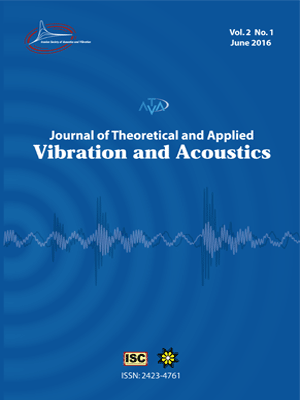
Journal of Theoretical and Applied Vibration and Acoustics

Journal of Theoretical and Applied Vibration and Acoustics

The Journal of Theoretical and Applied Vibration and Acoustics (TAVA) is an Open Accesses biannual publication sponsored by the Iranian Society of Acoustics and Vibration. 

The journal is the venue for publication of original research concerning mechanical vibration and acoustics.

TAVA follows the Committee on Publication Ethics (COPE) principles and its guidelines on dealing with acts of misconduct, thereby investigating allegations of misconduct to ensure the research integrity.more...

Keywords Cloud

  • Nonlinear vibration
  • Optimization
  • Energy Harvesting
  • Vibration Analysis
  • wave propagation
  • Model updating
  • Free vibration
  • finite element method
  • natural frequency
  • Condition monitoring
  • Bifurcation
  • Piezoelectric
  • Ritz method
  • mosque
  • Multiple Scales Method
  • Nonlocal elasticity theory
  • finite element analysis
  • MCST
  • Resonance
  • Uncertainty
  • optimal control
  • multi-frequency excitation
  • Vibration measurement
  • Magnetorheological fluid
  • acoustics
  • Convolutional neural network
  • reverberation time
  • method of multiple scales
  • Isogeometric Analysis
  • Metamaterial
  • Campbell diagram
  • Experimental modal analysis
  • genetic algorithm
  • Fault diagnosis
  • Feed-forward neural network
  • Rough Interface
  • Flow-induced vibration
  • Base Excitation
  • Noise reduction
  • Feature Extraction
  • piezomagnetoelastic
  • Internal combustion engine
  • Intelligent controller
  • damage detection
  • Rayleigh-Ritz method
  • Artificial neural network
  • Galloping
  • Rolling element bearing
  • Thermal gradient
  • Hysteresis loop
  • Clearance
  • System identification
  • Iwan model
  • Vibration
  • identification
  • Volume
  • Form
  • Modified couple stress theory
  • noise pollution
  • Architectural acoustics
  • sound pressure level
  • chaos
  • Magnetorheological Damper
  • Transition zones
  • Finite Element Analysis (FEM)
  • Austenitic weld
  • Contact zone element
  • sound reduction
  • Under platform damper
  • Necking
  • FSI
  • Thin layer interface
  • Fast Fourier Transform
  • combustion instability
  • Multipath Circuits
  • Complexification averaging method
  • frequency adjustment
  • Sound propagation
  • EPP SDOF system
  • CFD
  • Flight phase
  • Reactive muffler
  • ECAP process
  • Health risk
  • Transfer matrix method
  • Integrated vehicle control
  • Mortar Joints
  • Active force controller
  • Maximum displacement
  • Piezolaminated sandwich beam
  • Sensitive-payload
  • Square-section cylinder
  • Gibbs-Appell
  • lock-in
  • Microslip
  • Rotational energy harvester
  • Milling
  • Optimum control effort
  • Rotor dynamics
  • Active suspension system
  • Height
  • Instantaneous angular speed
  • Foundation stiffness
  • Zero thickness element
  • Flexibility Deflection
  • Sliding Mode
  • Operational Modal Analysis
  • Critical speed
  • Dynamic Analysis
  • COMSOL
  • Arc length continuation method
  • wake oscillator model
  • Modal Inertia
  • Torsional vibratio
  • Flight maneuvers
  • In-plane vibration
  • Parameter estimation
  • Diameter
  • Primary resonance
  • Time history
  • Predetermined Focal Points
  • Amine Cycle
  • Particle Swarm Optimization
  • Viscoelastic damper
  • Functionally-Graded Material
  • Arbitrary boundary
  • Acoustical conditions
  • Early fault detection
  • Time-varying irregularities
  • Absorption coefficient
  • Vehicle Pitch
  • Impact phase
  • Trace envelope
  • Nonlocal
  • Kelvin–Voight foundation
  • Track dynamic behavior
  • Vibration Control
  • Forward Directivity Effect
  • stacked autoencoder
  • fault detection
  • Shear layer stiffness
  • Optimisation
  • Transmissibility
  • Mesh size
  • Electromagnetic Induction Sensor
  • mass-damping parameter
  • time delay
  • Message Passing Interface (MPI)
  • Nonlinear forced vibrations
  • Continuous modeling
  • Virtual Sources
  • Mass Ratio
  • Time-varying frequency content
  • Near-Fault Zone
  • Iterative learning
  • Modal strains
  • Corrosion
  • stability
  • collaborative simulation
  • Centrifugal Compressor Train
  • Cut-off Frequency
  • PZT energy harvesting
  • microbeam
  • Neural network
  • Town Board Stations (TBS)
  • GTAW
  • Friction and contact
  • Absolute attenuation
  • Knudsen number
  • Stress analysis
  • Gearbox Fault Diagnosis
  • Updating
  • Finite volume element
  • Torsional vibrations
  • Porous media
  • two-layered microplate
  • Nonlinear dynamical systems
  • Koopman operator
  • form finding
  • Ultrasonic technique
  • vibration damping
  • Malfunction of Ignition System
  • Mode decoupling
  • Differential Quadrature Method
  • Micro-cantilever Beam
  • Vibrating FG micro-plate
  • Metro stations
  • Theoretical method
  • Nonlinear vibrations
  • synchronization
  • Human Body
  • general nonlocal theory
  • Fifth wheel coupling system
  • Nonlocal and length-scale parameters
  • Composite plate
  • Machine Learning
  • Pilot body vibration
  • Frequency up-conversion
  • Separator
  • Flexible link